They Weren't Short on Leads.
They Were Drowning in the Wrong Ones.
If you run a home service business, you already know this feeling. The phone rings, the form gets filled, the message comes in — and then you spend 20 minutes on a call to find out the person wanted a 10x10 deck for $800. Or they were "just getting prices." Or they disappear the moment you send the quote.
That was everyday life for Tennessee Deckworks before we worked together. They were running Facebook ads on their own — boosting posts, trying different things — and getting activity. But activity isn't revenue. And the leads that were coming in weren't the ones that would keep their crew busy on premium, high-ticket builds.
What Their Lead Pipeline Looked Like Before
- Random inquiries with no budget clarity and no real intent to buy
- Price shoppers comparing 5 contractors to find the cheapest option
- "Just exploring" homeowners who weren't ready to move for months
- Ad spend going out every month with no predictable return coming back
- Crew capacity sitting underutilized because qualified jobs weren't flowing consistently
This isn't a volume problem. Tennessee Deckworks could get leads. What they couldn't get — on their own — was qualified leads. Homeowners who had a real project, a real budget, and were ready to have someone out for an estimate this week.
"Most home service businesses think they need more leads. What they actually need is better leads — and a system that gets those leads booked before they go cold."
Stop Chasing Volume.
Start Filtering for Intent.
When we took over Tennessee Deckworks' lead generation, the first thing we didn't do was run more ads. The first thing we did was build a system designed to attract the right homeowner and disqualify everyone else before they wasted anyone's time.
That meant three things had to work together:
High-Intent Facebook Campaigns
We didn't just boost posts or run generic "get a free quote" ads. We built campaign creative specifically designed to speak to homeowners who were already thinking about a deck project — and to repel casual browsers. The messaging, visuals, and targeting were dialed in to attract people with serious projects and serious budgets.
Strong Pre-Qualification Before Anyone Touched the Phone
Every lead had to pass through qualification before it ever landed on Tennessee Deckworks' desk. Budget thresholds, project timelines, homeowner status — the funnel filtered for exactly the kind of client they wanted. If someone wasn't a fit, they self-selected out early. No wasted calls, no wasted site visits.
Appointment-First Funnel — Not Just a Lead Drop
Most ad systems deliver a name and a phone number and call it a lead. We built toward the onsite appointment as the goal. A lead that doesn't become a booked estimate is just a contact — and contacts don't pay the crew. The entire back-end was designed to move qualified homeowners directly onto the calendar.
The result wasn't just more leads — it was a completely different quality of conversation. Instead of chasing people down, Tennessee Deckworks was showing up to homes where the homeowner was already sold on the idea, already had a budget range in mind, and just needed someone to show them what was possible.
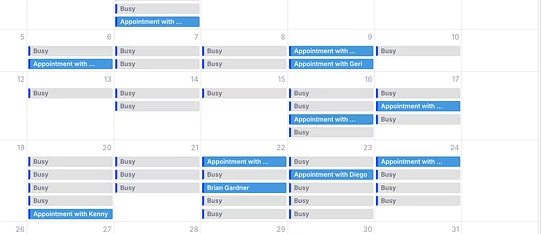 September — calendar packed with booked onsite appointments.
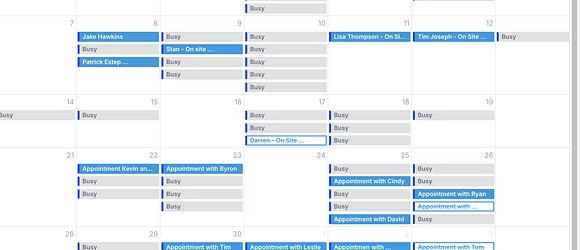 October — the momentum kept building with even more onsite visits.
What the Campaign Data Actually Showed
Here's how the Facebook Ads performed across the key campaigns over the 90-day period. The numbers tell a clean story — as the creative and targeting got refined, the cost per lead came down while the quality of leads went up.
| Campaign / Ad Creative | Leads | Ad Spend | Cost / Lead |
|---|---|---|---|
| Before/After | Dynamic Creative (Primary) | 51 | $3,661.88 | $71.80 |
| Video Creative Testing 1 (11/3/25) | 21 | $1,275.54 | $60.74 |
| Video Creative Testing 1 Dup (11/10/25) | 14 | $892.84 | $63.77 |
| Gameday Video Ad (9/21/25) | 8 | $653.87 | $81.73 |
| Static Creative Testing 3 (8/30/25) | 15 | $540.47 | $36.03 |
| Video Creative Testing 4 (8/24/25) | 7 | $437.24 | $62.46 |
| Broad Targeting Campaign (8/18/25) | 167 | $10,518.73 | — |
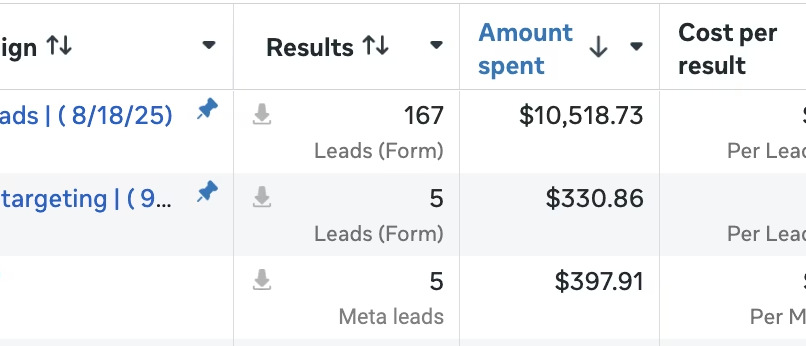 Broad campaign results — 167 leads at $10.5K spend.
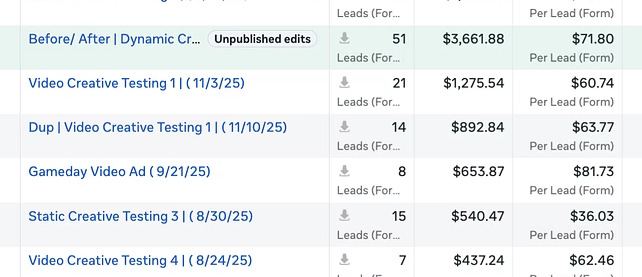 Creative testing breakdown — CPL dropped as low as $36.
Notice what happened over time: the creative testing process wasn't just about getting leads cheaply — it was about identifying which messages attracted the homeowners most likely to convert to a booked appointment. That's a different optimization target than most agencies work toward.
90 Days. A Business That Looks Completely Different.
By the end of the 90-day window, Tennessee Deckworks wasn't the same business they were when we started. The lead quality shift alone changed how their team operated — less time on the phone chasing dead ends, more time on job sites doing the work they're actually good at.
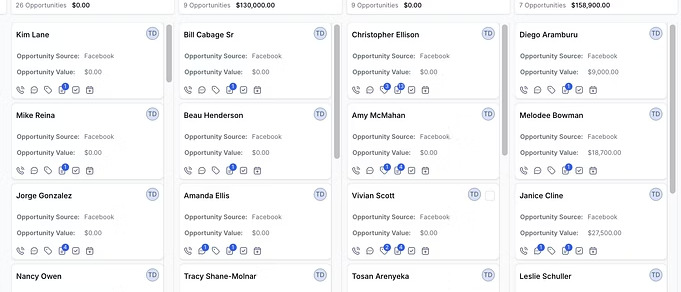 The resulting CRM pipeline: $158K+ in closed revenue and a stack of open
opportunities.
The resulting CRM pipeline: $158K+ in closed revenue and a stack of open
opportunities.
Think about what a 37% lead-to-appointment rate means in practice. For every 3 leads that came in, more than 1 turned into a booked site visit. That's not a typical number. Most businesses running their own ads are thrilled to convert 10–15% of leads to appointments — and that's if they follow up fast enough.
And the $15K+ average deal size means this wasn't filler work. Every appointment on that calendar represented a real, high-ticket deck project — the kind of jobs that make a season profitable.
With $225K+ still sitting in pipeline, the 90-day window wasn't the end of the story. It was the foundation of a business that now has consistent, predictable deal flow — without relying on word of mouth or hoping the phone rings.
The Problem Was Never the Ads.
It Was the System Behind Them.
Tennessee Deckworks was already running ads before we worked together. They weren't doing nothing. But there's a massive difference between boosting a post and running a lead generation system built to qualify, convert, and book.
If you're a home service business owner reading this — deck builder, roofer, landscaper, remodeler, exterior cleaner — the story probably sounds familiar. You've tried ads. Maybe they worked a little, maybe they didn't. But what you likely didn't have was the full system: the right campaign structure, the qualification layer, and the appointment-first follow-up that turns a lead into a job.
That's exactly what changed for Tennessee Deckworks. And $158K in 90 days is what it looks like when all three pieces work together.
Sound Familiar?
- You're getting leads but most of them aren't serious buyers
- You're spending money on ads without a clear system to convert them
- Your schedule has gaps because qualified jobs aren't flowing consistently
- You're doing the follow-up yourself and it's falling through the cracks
The question isn't whether ads can work for your business. They can — we have the numbers across deck building, roofing, remodeling, landscaping, and exterior cleaning to prove it. The question is whether you have the right system behind them.
Book Your Growth Strategy Call →